
Lite mode. Switch to Full
invert_colors
logout
/sci/
/sci/
Post a Replyarrow_backarrow_downward
MoscowShare what you've learned recentlyBernd2026-06-28 18:43:31 · 2wNo. 362281reply
I like watching pop science videos, reading scientific books, and I want to share my summaries of them here. Of course everyone else is welcome to share any sort of fun fact or idea that they don't think needs a separate thread.
 
I have already written some, I'll crosspost them here.
MoscowBernd2026-06-28 18:46:01 · 2wNo. 362282reply
My most important conclusion first: Human-animal communication gap is quite extreme, so it's fascinating when scientists manage to cross it. In fact, I even think it could help us learn more about human-human communication gaps. See the challenges that these scientists experienced, and try asking yourself: could these difficulties exist between individuals, too?
 
>Scientists Made Movies For Chimpanzees (They LOVED It)
My interpretation of this guy's video down there lol so feel free to read if you're bored
 
Great Ape cognition studies.
>
Japan is doing a lot of work in the realm of animal cognition studies. For example, they proved small fish can recognize themselves in the mirror, and not only that, but that research has to be conducted in a way that animals will care.
 
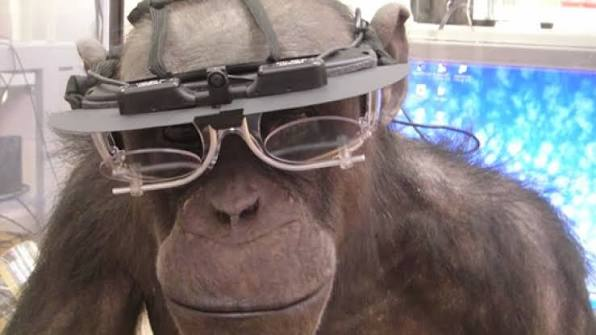
Enter Fumihiro Kano. Here are his experiments on the chimpanzees and other apes, which happened in the 2010's.
 
Can chimpanzees infer intent? He showed his test subjects a video where his hand is reaching for one of the two toys. After showing that a few times, he'd switch to a video where the toys change their positions and the hand stops before it chooses one of them. The apes correctly inferred that the hand would pick the same toy as usual. (because their eyes were tracked) These are similar results to the same experiments conducted on human infants.
 
Then, the famous Sally-Anne experiment. This one is also about inferring the intent and one famously failed by autists, but not the neurotypicals or people with Down's. The chimpanzees, however, did not care about this experiment.
 
He met Satoshi Hirata who told him the chimpanzees do not like static experiments, television, or videos in general. This is when they decided… to do live action movies for them!
 
Movie 1. King Kong attack.
The scientists asked themselves - can the chimpanzees recall an event that only happened once? Could a complex scenario hold their attention?
They positioned 2 researchers near 2 different doors respectively. Then, out of one of these doors professor Hirata would jump out and attack. 24 hours later when the experiment was repeated, the chimpanzees paid more attention to the door Hirata came out of.
…But more importantly, they were very engrossed while watching it happen, to the point they would stop drinking the juice given to them by handlers!
 
Movie 2. King Kong hiding
This is the live action version of the Sally-Anne experiment, and yes, it showed that great apes may very well be capable of evaluating false belief.
The movie was as follows. King Kong jumps out of a bush to attack a human and then hides in one of them. While the human leaves to get a weapon, King Kong runs away entirely. The apes looked at the bush the King Kong hid previously, anticipating that the human would hit it.
 
Finally, the question they asked was: How do chimpanzees come to understand these ideas, exactly? Was it due to experience?
So basically they introduced the idea of opaque/transparent obstacles to the original Sally-Anne and, yeah, the chimpanzees familiar with transparent obstacles figured out the human saw the toy gone from the box.
 
Interesting stuff, but the most interesting of all is how much they loved live action scenarios. Imagine studying which ones they prefer exactly, too! So many possibilities.

MoscowBernd2026-06-28 18:50:51 · 2wNo. 362283reply
Main conclusion: As long as society has existed, humans have always offloaded skills somewhere or delegated them to someone. This causes degradation of certain skills in exchange of being able to invest cognitive resources elsewhere. Now that we're able to offload cognition to AI, what happens now?
 
>Humans Are Becoming Dogs (Science Proves it)
by Emily Higgins
 
I'm sure everyone has heard about humans "self-domesticating" themselves by now. Our brains shrunk, we became more neotenous compared to our ancestors, we became more friendly. The hypothesis is that humans self-bred for friendliness.
 
What's interesting is that she mentions "the impossible box study" involving wolves and domesticated dogs. Wolves would stick to trying to solve the box for a long time - they were much more persistent, whereas dogs would soon start glancing at humans after a few attempts.
 
There's a few interpretations of this study.
The video author says that selection for cooperation makes animals and humans offload tasks to specialists - something integral to our societies.
A good example of offloading is writing - many years ago Plato warned that writing will have an adverse effect on our memory because we wouldn't need to hold things in our head anymore. (use it or lose it - obviously
https://pmc.ncbi.nlm.nih.gov/articles/PMC7181563/
 
The main point of the video is, are we starting to offload our intelligence, like the dogs in the impossible task? The Flynn effect started reversing in many countries recently, and our offloading tools have become extremely powerful - not just for memory, but cognition itself - AI. Is this a good or a bad thing, ultimately?
 
To quote the video, "We're the first species to watch our own domestication happen. The dog is not a failed wolf, but merely one that traded some traits for others. So the question becomes not whether AI is going to make us dumber - but what are we going to choose to delegate, and what will we choose to do ourselves? Perhaps the most important skill of the future is not making things or knowing things, but being able to decide what to give away and what not to give away. The leash, this time, is in our own hands."
MoscowBernd2026-06-28 19:31:05 · 2wNo. 362291reply
Also
>Humans Are Becoming Dogs
He was ahead of the curve...
United StatesBernd2026-06-28 19:42:13 · 2wNo. 362292reply
Bingo!
CanadaBernd2026-06-29 22:20:26 · 2wNo. 362353reply
Does How to commit more warcrimes count?
United StatesBernd2026-06-29 23:36:06 · 2wNo. 362355reply
I recently learned that science actually doesn't know what gravity is, doesn't know what an atom looks like, doesn't know what light is, doesn't know the origin of the Universe and to top it all off, we now think that time doesn't even exist.
United StatesBernd2026-06-30 19:34:31 · 1wNo. 362398reply
Humans Just make words up for said stuff,etc.
CaliforniaBernd2026-06-30 19:47:49 · 1wNo. 362408reply
Yup,welcome to the club.
/sci/Post a Replyarrow_backarrow_upward