My most important conclusion first: Human-animal communication gap is quite extreme, so it's fascinating when scientists manage to cross it. In fact, I even think it could help us learn more about human-human communication gaps. See the challenges that these scientists experienced, and try asking yourself: could these difficulties exist between individuals, too?
>Scientists Made Movies For Chimpanzees (They LOVED It)
My interpretation of this guy's video down there lol so feel free to read if you're bored
Great Ape cognition studies.
>
Japan is doing a lot of work in the realm of animal cognition studies. For example, they proved small fish can recognize themselves in the mirror, and not only that, but that research has to be conducted in a way that animals will care.
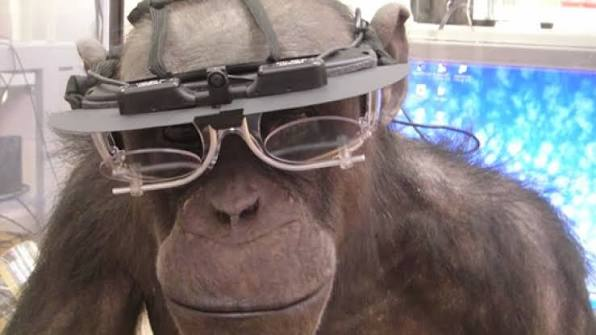
Enter Fumihiro Kano. Here are his experiments on the chimpanzees and other apes, which happened in the 2010's.
Can chimpanzees infer intent? He showed his test subjects a video where his hand is reaching for one of the two toys. After showing that a few times, he'd switch to a video where the toys change their positions and the hand stops before it chooses one of them. The apes correctly inferred that the hand would pick the same toy as usual. (because their eyes were tracked) These are similar results to the same experiments conducted on human infants.
Then, the famous Sally-Anne experiment. This one is also about inferring the intent and one famously failed by autists, but not the neurotypicals or people with Down's. The chimpanzees, however, did not care about this experiment.
He met Satoshi Hirata who told him the chimpanzees do not like static experiments, television, or videos in general. This is when they decided… to do live action movies for them!
Movie 1. King Kong attack.
The scientists asked themselves - can the chimpanzees recall an event that only happened once? Could a complex scenario hold their attention?
They positioned 2 researchers near 2 different doors respectively. Then, out of one of these doors professor Hirata would jump out and attack. 24 hours later when the experiment was repeated, the chimpanzees paid more attention to the door Hirata came out of.
…But more importantly, they were very engrossed while watching it happen, to the point they would stop drinking the juice given to them by handlers!
Movie 2. King Kong hiding
This is the live action version of the Sally-Anne experiment, and yes, it showed that great apes may very well be capable of evaluating false belief.
The movie was as follows. King Kong jumps out of a bush to attack a human and then hides in one of them. While the human leaves to get a weapon, King Kong runs away entirely. The apes looked at the bush the King Kong hid previously, anticipating that the human would hit it.
Finally, the question they asked was: How do chimpanzees come to understand these ideas, exactly? Was it due to experience?
So basically they introduced the idea of opaque/transparent obstacles to the original Sally-Anne and, yeah, the chimpanzees familiar with transparent obstacles figured out the human saw the toy gone from the box.
Interesting stuff, but the most interesting of all is how much they loved live action scenarios. Imagine studying which ones they prefer exactly, too! So many possibilities.