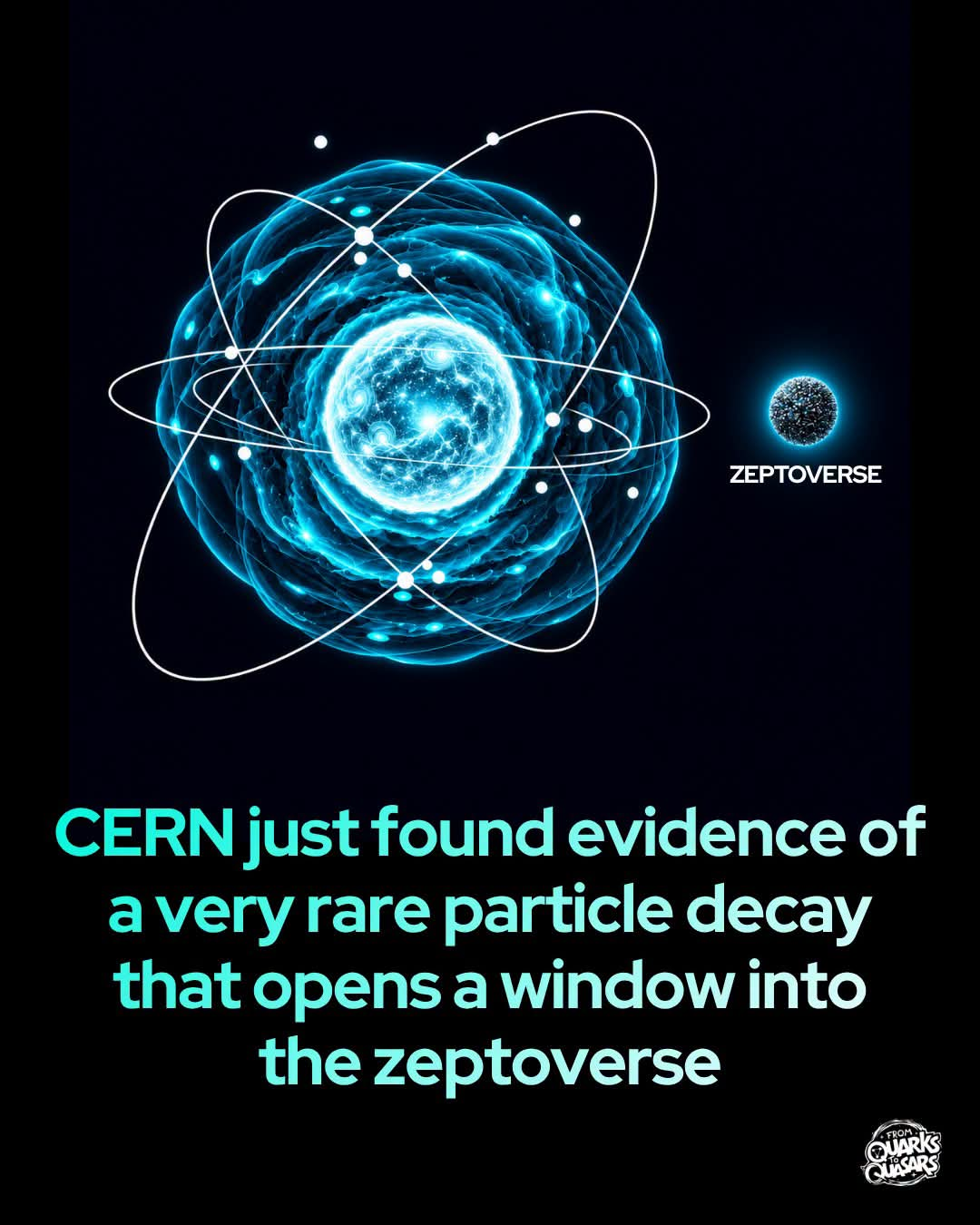
The zeptoverse is an unimaginably small scale of physical reality—measured in zeptometers, or one sextillionth of a meter (10⁻²¹ meters), which is roughly 100 billion times smaller than an atom. [1] (https://www.bbc.com/news/articles/c5pvgxkkv4dzo), [2] (https://www.wired.com/story/particle-physicists-are-getting-a-first-glimpse-into-the-zeptoverse/), [3] (https://www.newscientist.com/article/2597289-beauty-particle-decay-opens-the-door-to-the-zeptoverse/)
Recent Breakthrough at CERN
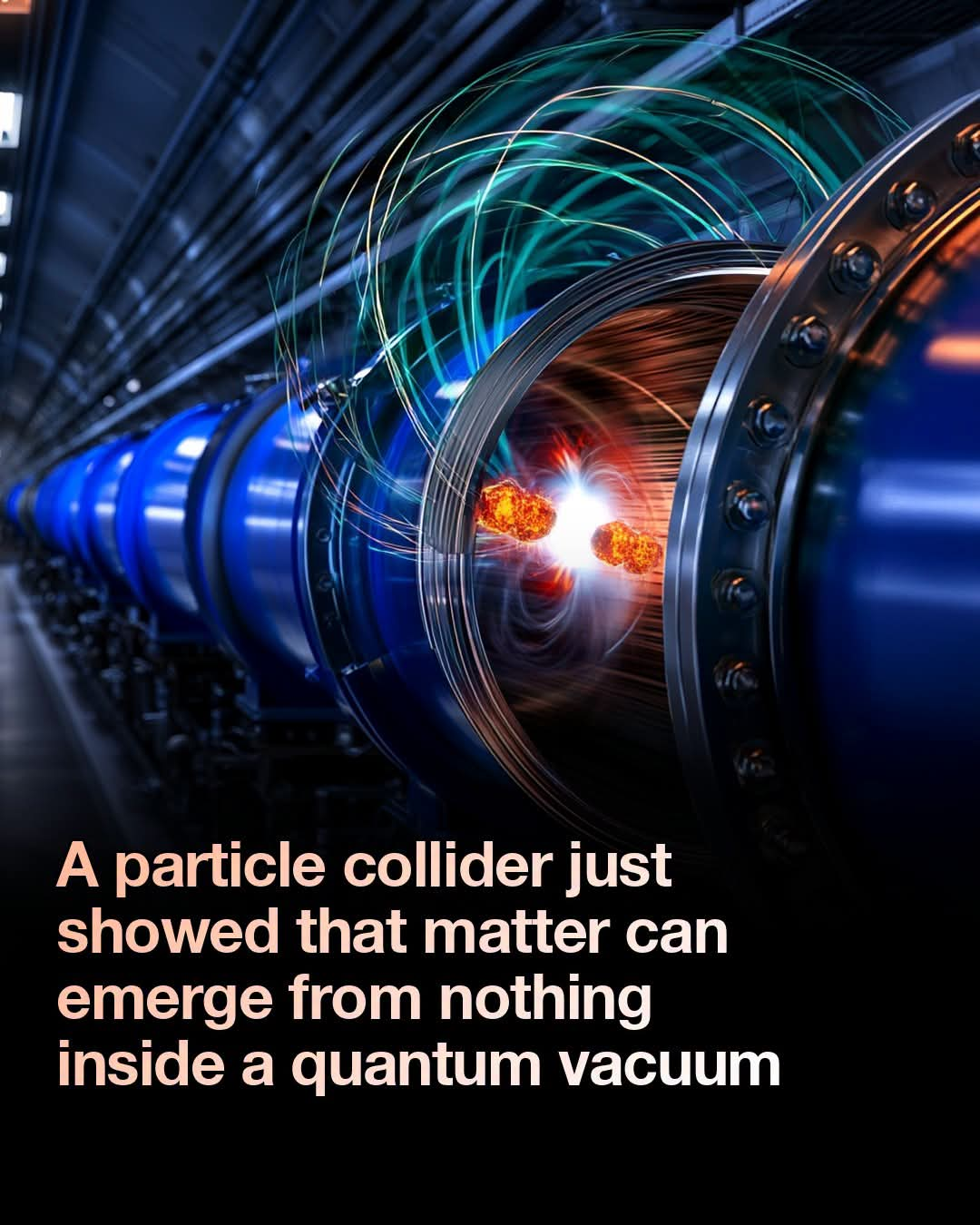
In November 2026, researchers at the Large Hadron Collider (LHC) working on the LHCb experiment announced the first evidence of a long-sought, extraordinarily rare subatomic process that provides a direct window into this realm: [1] (https://www.cam.ac.uk/stories/zeptoverse), [2] (https://www.wired.com/story/particle-physicists-are-getting-a-first-glimpse-into-the-zeptoverse/), [3] (https://www.newscientist.com/article/2597289-beauty-particle-decay-opens-the-door-to-the-zeptoverse/)
• The Decay: Scientists observed a neutral "beauty" particle (containing a beauty quark) decaying into a muon and an antimuon (\(B_s \to \mu^+\mu^-\)). [1] (https://phys.org/news/2026-11-physicists-closer-zeptoverse-year-particle.html), [2] (https://www.wired.com/story/particle-physicists-are-getting-a-first-glimpse-into-the-zeptoverse/), [3] (https://www.newscientist.com/article/2597289-beauty-particle-decay-opens-the-door-to-the-zeptoverse/)
• Rarity: According to the Standard Model of particle physics, this transformation happens only about once in every 10 billion decays. [1] (https://www.wired.com/story/particle-physicists-are-getting-a-first-glimpse-into-the-zeptoverse/), [2] (https://www.newscientist.com/article/2597289-beauty-particle-decay-opens-the-door-to-the-zeptoverse/)
• Significance: The measurement reached 3.2 sigma (first evidence, though short of the 5 sigma required for a full physics discovery). [1] (https://www.newscientist.com/article/2597289-beauty-particle-decay-opens-the-door-to-the-zeptoverse/), [2] (https://phys.org/news/2026-11-physicists-closer-zeptoverse-year-particle.html)
• Why it matters: Because this decay is so rare, it acts as a sensitive probe. If undiscovered forces or particles—such as those related to dark matter or dark energy—exist at the zeptometer scale, they can subtly alter how often or how fast these beauty quarks decay. [1] (https://www.euronews.com/video/2026/11/05/zeptoverse-cern-scientists-uncover-evidence-of-extraordinarily-rare-particle-decay), [2] (https://www.newscientist.com/article/2597289-beauty-particle-decay-opens-the-door-to-the-zeptoverse/), [3] (https://www.cam.ac.uk/stories/zeptoverse)
Read more about the findings in the official report from the University of Cambridge or coverage via WIRED. [1] (https://www.wired.com/story/particle-physicists-are-getting-a-first-glimpse-into-the-zeptoverse/), [2] (https://www.cam.ac.uk/stories/zeptoverse)
Would you like to know more about how beauty quarks work or how physicists use particle decays to search for dark matter?