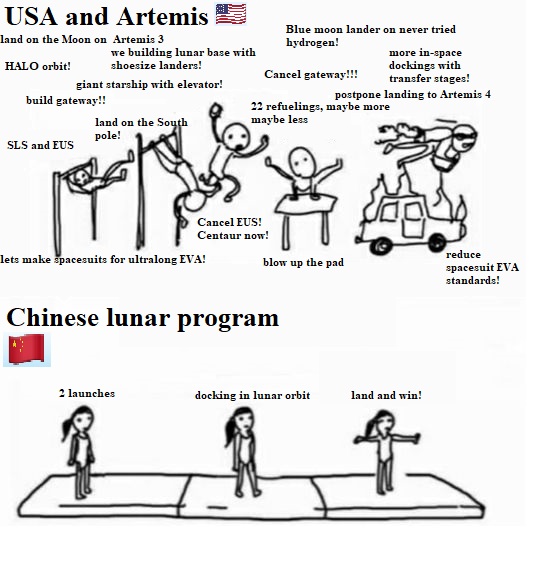
Americans are currently projected to land on the Moon first in the 21st century, but the race is extremely close. While the United States holds a slight lead in the scheduled timeline, China’s highly consistent execution means any further American delays could hand the victory to Beijing. [1] (https://tech-insider.org/china-manned-moon-landing-two-launches-lunar-orbit-rendezvous-2026/), [2] (https://www.cbc.ca/news/science/space-race-us-china-moon-9.7150635), [3] (https://www.newsweek.com/china-could-beat-us-back-moon-former-astronaut-warns-2097709), [4] (https://www.youtube.com/shorts/TiBhTcpuurE), [5] (https://www.youtube.com/shorts/HyUgLURmOPs)
Here is how the current schedules, strategies, and risks compare for both nations:
📅 The Timelines
• The United States (NASA Artemis Program): NASA successfully completed its crewed lunar flyby (Artemis II) in April 2026. Following a program restructuring, Artemis III is slated for a mid-2027 Earth-orbit demonstration to test commercial lunar landers. This places the first actual American human lunar landing on Artemis IV, currently targeted for 2028. [1] (https://en.wikipedia.org/wiki/Artemis_III), [2] (https://tech-insider.org/china-manned-moon-landing-two-launches-lunar-orbit-rendezvous-2026/)
• China (CNSA Lunar Program): The China Manned Space Agency (CMSA) has explicitly and repeatedly committed to landing taikonauts on the moon before 2030, with a targeted window of 2029 or 2030. [1] (https://azmth.space/answers/china-moon-landing), [2] (https://tech-insider.org/china-manned-moon-landing-two-launches-lunar-orbit-rendezvous-2026/)
🚀 Direct Comparison of Approaches
Metric / Detail 🇺🇸 United States (Artemis) 🇨🇳 China (CMSA)
Target Landing Year 2028 (on Artemis IV) 2029–2030
Mission Architecture Single Space Launch System (SLS) rocket carries the Orion capsule; docks with a commercially provided lander pre-staged in lunar orbit. Dual-launch profile using two Long March 10 rockets; the Lanyue lander and Mengzhou capsule rendezvous and dock in lunar orbit.
Primary Vehicles SLS Rocket, Orion Spacecraft, SpaceX Starship / Blue Origin Blue Moon landers. Long March 10 Rocket, Mengzhou Crew Ship, Lanyue Lunar Lander.
Core Advantage Highly advanced commercial private space economy (SpaceX, Blue Origin) and massive accumulated experience from the Apollo era. State-backed, reliable long-term planning with a flawless robotic lunar track record (Chang'e missions).
Core Risk Complex supply chains, bureaucratic shifts, and deep dependency on commercial landers that are still heavily under development. Rigid engineering timelines leaving narrow margins for unexpected system failures during upcoming prototype flights.
⚖️ The Verdict
While NASA has a technical 1 to 2-year schedule advantage, aerospace experts widely note that China's timeline is highly stable. Because the American program relies on complex, untried hardware like SpaceX's Starship and Blue Origin's Blue Moon landers—both of which must undergo rigorous uncrewed tests before putting humans on the moon—any major setback could push the American landing past 2030. [1] (https://en.wikipedia.org/wiki/Artemis_III), [2] (https://tech-insider.org/china-manned-moon-landing-two-launches-lunar-orbit-rendezvous-2026/), [3] (https://www.youtube.com/shorts/TiBhTcpuurE), [4] (https://www.youtube.com/shorts/HyUgLURmOPs)
If the current US timeline holds, Americans will land first. If NASA encounters another significant delay, China is well-positioned to take the lead. [1] (https://www.youtube.com/shorts/HyUgLURmOPs), [2] (https://tech-insider.org/china-manned-moon-landing-two-launches-lunar-orbit-rendezvous-2026/), [3] (https://www.newsweek.com/china-could-beat-us-back-moon-former-astronaut-warns-2097709)
Would you like to explore the specific landing zones both nations are targeting near the lunar south pole, or look closer at how SpaceX and Blue Origin's lander designs compare to China's Lanyue lander? [1] (https://en.wikipedia.org/wiki/Artemis_III), [2] (https://www.cbc.ca/news/science/space-race-us-china-moon-9.7150635), [3] (https://tech-insider.org/china-manned-moon-landing-two-launches-lunar-orbit-rendezvous-2026/)