
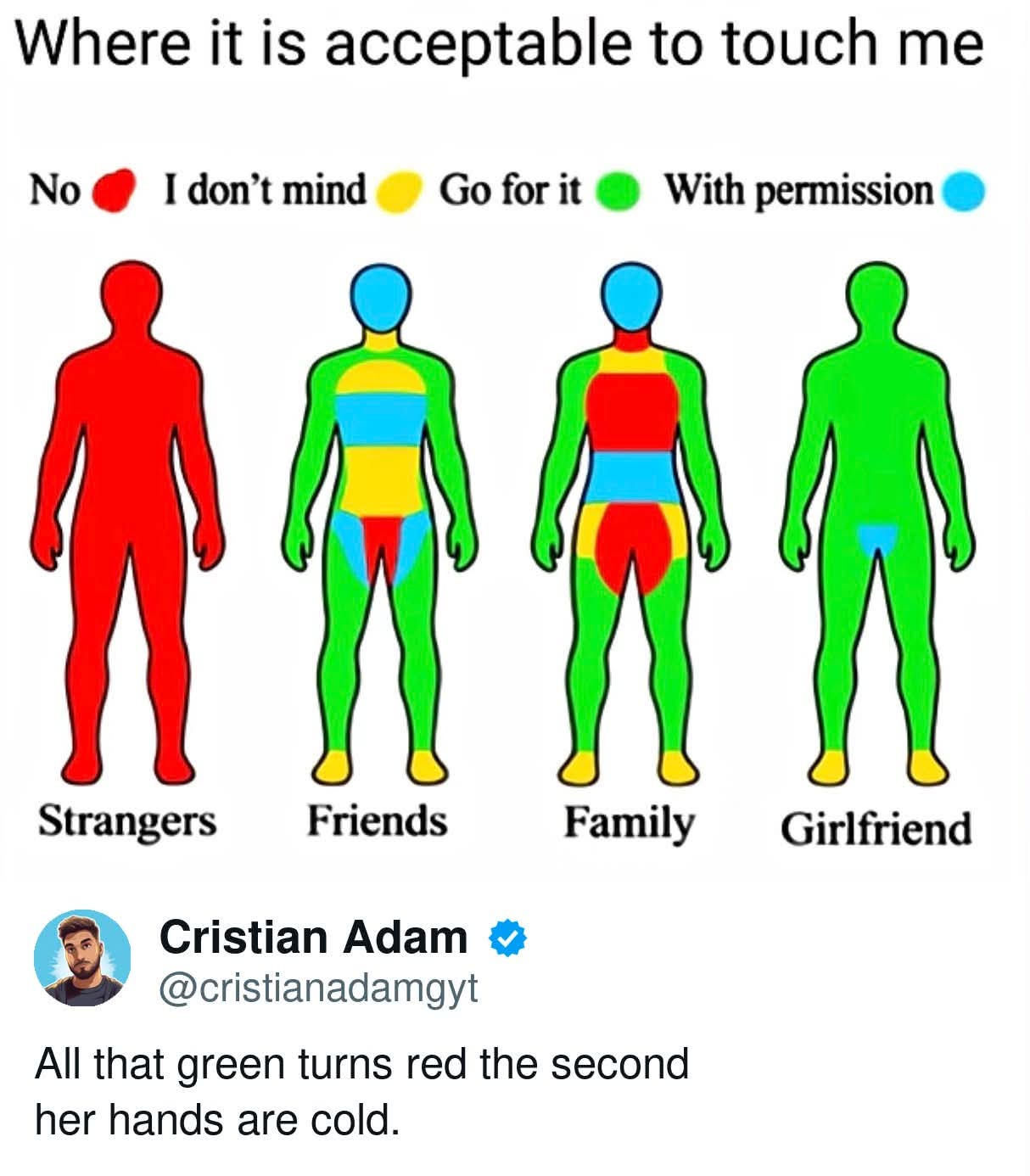

I don't like being touched at all
There's an actual study behind this chart. In 2015, researchers at Aalto University in Finland and the University of Oxford asked 1,368 people from Finland, France, Italy, Russia and the UK to color in body silhouettes showing where different people in their lives were allowed to touch them. The more emotionally close the person, the more of the body was open to them. Partners could touch basically anywhere. Close friends and relatives got the head and upper body. Strangers got the hands, which is the handshake.
Some areas were off limits to nearly everyone outside a partner, and the results were remarkably similar across all five countries. The researchers also found that the more pleasurable a part of the body is to touch, the more selectively people allow it. That's why the map narrows so fast outside the inner circle.
The size of the touchable area followed how close the person felt, and not how recently you'd seen them. A friend you haven't spoken to in a year still gets the same map as the one you see every week.
The researchers' conclusion is that touch is one of the ways humans build and keep their relationships, much like grooming in other primates. In my opinion, women on the other hand are like a feline. Ifykyk

People have a variety of physical, emotional, and cultural reasons why they might not want family members to touch their neck. Because the neck is a vulnerable area of the body, discomfort around it being touched is very common.
Personal & Emotional Boundaries
• Intimate or erogenous zone. For many people, the neck is a highly sensitive or romantic area, which makes touch from relatives feel uncomfortable or inappropriate, as one user shared on Reddit's TrueOffMyChest. [1] (https://www.reddit.com/r/TrueOffMyChest/comments/r8dlkd/my_family_member_touch_my_neck_and_forgets_he/)
• Bodily autonomy. Everyone has different comfort levels with physical affection, and setting boundaries around specific body parts is a normal way to feel safe and respected.
• Past trauma. Someone who has experienced physical or emotional trauma—especially involving the throat or neck—may have an immediate, involuntary panic or defensive response to touch in that area.
Physical & Sensory Reasons
• Sensory sensitivity. Some individuals experience tactile hypersensitivity, meaning light or unexpected touch on the neck feels overwhelming, painful, or irritating, which users on Quora note is often tied to sensory processing differences.
• Vulnerability reflex. Because the neck protects vital airways and blood vessels, humans naturally have a protective reflex that makes them flinch or tense up when hands come near their throat.
• Medical tenderness or pain. Conditions like muscle strain, pinched nerves, or swollen lymph nodes—which UPMC HealthBeat notes can cause tenderness and pain—can make even gentle contact hurt.
• Newborns and infants. For babies, the neck muscles are weak and the head is heavy, so family members are often told not to touch or grab the neck to prevent accidental injury and ensure proper head support. [1] (https://www.upmc.com/healthbeat/family-health/swollen-lymph-nodes-in-neck), [2] (https://www.quora.com/Recently-I-just-cant-stand-having-anything-touch-my-neck-high-collar-necklace-tangled-earpiece-or-even-strands-of-my-own-hair-when-lying-down-I-do-not-have-any-trauma-or-anything-related-to-the-neck-Any-explanation)
Social & Cultural Context
• Cultural norms. Depending on a family's background, touching someone's head or neck can be viewed as overly dominant, disrespectful, or intrusive.
• Respecting explicit requests. Regardless of the underlying reason, once someone asks not to be touched in a certain spot, continuing to do so crosses a clear personal boundary.
Are you asking about a specific situation (like a family member setting this boundary, a rule for holding a baby, or a rule from a specific culture or story)? Sharing a little more context can help me give you a much more exact answer!
